Doctors in the 1800s - Bankruptcy and rapid turnover
1840s - 1850s
The village doctor from the early 1840s to around 1850 was Charles Butler; he lived at 50 High Street ('The White House' on the corner of Park Lane). He died early in the 1850s but his family continued to live in the house until the early 1920s.
In 1848 Doctor Charles Frederick Edwards took the lease of 'a House and Land, formerly known as the "Bell Inn", plus the parcel of pasture land known as the Orchard and Bell Close'. His immediate predecessor in The Bell House had been the publican, Thomas Ferris, who moved to be landlord of The Wellesley Arms.1848 Lease to Dr Edwards
Edwards may have had some financial issues at the beginning of his career. Shortly after he arrived, he borrowed £300 from the vicar, Reverend George Marsh. For security he used a £300 Life Insurance policy which he took out on himself.
Loan to Dr Edwards 1
1860s - 1900s
Dr Edwards was followed at The Bell by Dr George Simmons (or Symmons / Symons), and then in 1862 by Dr Henry Ryley. Ryley appears in the 1865 Harrod's Directory, but had left by 1871. He also seems to have had some money problems and was declared bankrupt in 1866; a complicated paper trail in the archives shows insurance policies and re-mortgages, including a debt of about £200, also to the vicar, Reverend Dawson.
1862 Lease to Dr Ryley
If anybody wants to write a Victorian melodrama about the financial hardships of doctors in the 1800s, there is obviously the basis of a good story here. However, for those who just want to read something similar that's already been written, try Anthony Trollope's Dr Thorne or Elizabeth Gaskell's shorter story Mr Harrison's Confessions.
The doctor in 1871 was local man Edward Little (whose wife Louisa was from Chippenham). He was followed by Dr Percie Garlike, who was the first since Dr Butler to stay more than a few years. He was in Sutton Benger from before 1885 until the early 1900s.
Doctor Charles Barnes was the last doctor to take the lease of The Bell House; he is shown in Kelly's Directory from 1905 to 1920. Dr Sturridge then bought the house and land in the Draycot Auction in 1920.
The Bell House; 1920s - 1940s
The village doctors leased The Bell House from the Draycot Estate until 1920, when Dr Sturridge bought it outright. There were at least three other doctors after him, all probably buying The Bell House in turn.
Nesta Heath recalls that:
... (in the 1920s / 1930s) the house included the doctor’s surgery, with a purpose-built consulting room, waiting room and dispensary. The door to the surgery was up several steps in Bell Lane. The location of this previous entrance can still be seen in the brickwork / paint on the side of the building. The entrance to the surgery was through a door on Bellside; although this entrance has since been blocked up, the outline of the doorway can still be seen in the paint if you look closely.
The doctor in 1935 was Frank Reginald Sawdon; Nesta Heath recalls that he was one of the first people in the village to own a car.
See: Nesta Heath, Life and Herbing in Sutton Benger, pp. 5-12.
In 1939 the doctor was a retired army officer, Lieutenant Colonel William Arthur Spong; his address appears in a Kelly's Directory of the time: Spong Lt.-Col. William Arthur B, RR, RCh., B.A.O.(Dublin), L M physician & surgeon, Bell house.
Bell Hotel 1940s
The Bell Hotel
By the late 1940s the doctor was Dr Clarke; he retired in about 1947-1948, and sold the building to Marco Berni Inns as a hotel; however, he sold the land separately to housing developers and the plot became known as 'Clarke's Lease'.
The Doctor's Surgery that Never Was
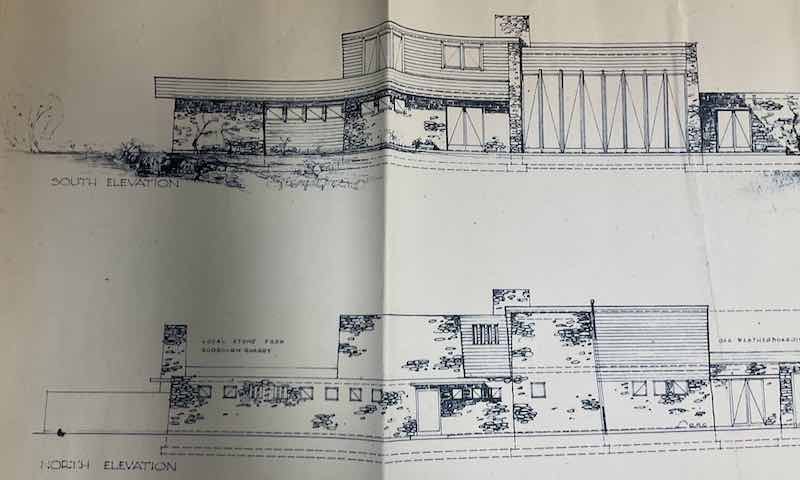
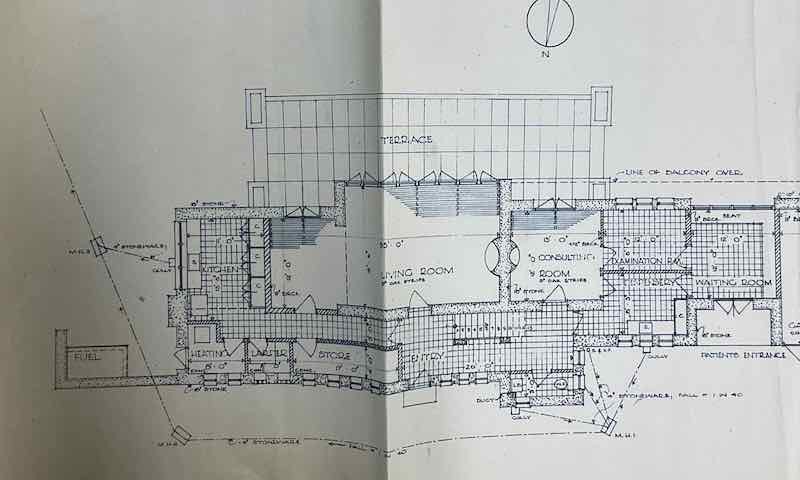
A 1947 document in the Archives at Wiltshire and Swindon History Centre (WSHC) shows a planning request from a Doctor Roberts for a large doctor's surgery to be built on Bell Piece, alongside Sutton Lane and between the High Street and Chestnut Road. It is not clear who Doctor Roberts was, nor whether he had an agreement to buy the land. The proposal did not receive planning consent because of its unsuitability in oh-so-many ways at the time, and nothing became of it. Doctor Roberts is not known to have been a doctor in the village. It was Dr Robinson who took over Dr Clarke's practice in about 1948, initially with a surgery in the skittle alley of The Wellesley Arms. She then moved her surgery to 54 High Street (The Rowans).
Dr Roberts House 1947
1947; Elevation view of Proposed House for Dr Roberts
1947; Ground floor, plan view of Proposed House for Dr Roberts
The Doctor's Surgery (1950s to today)
The village doctor in the 1950s and 1960s was Dr Robinson; she originally had her surgery in the skittle alley at The Wellesley Arms in the 1950s, then moved to 54 High Street (The Rowans) in the mid-1960s. She retired in about 1990, at which point Dr Wilkinson took over her practice, and the surgery moved to a temporary building next to the old village hall (roughly where the playground is today).
Marco Berni, who owned The Bell Hotel at that time, sold the plot opposite the Village Hall - the old Bell Inn kitchen gardens - with planning permission for a Doctor's Surgery. Dr Wilkinson's practice moved into the new building in about 1993, and it has remained there ever since.
Do you have any photos or memories of Dr Robinson's surgery in The Wellesley or at 54 High Street? Or do you have any photos of Dr Wilkinson's temporary surgery on the Rec? If so, please get in touch at hello@bengertrails.co.uk
Media Archive
Bell Hotel 1940s
1848 Lease to Dr Edwards
Loan to Dr Edwards 1
1862 Lease to Dr Ryley
Dr Roberts House 1947
1947; Elevation view of Proposed House for Dr Roberts
1947; Ground floor, plan view of Proposed House for Dr Roberts